
 How to Plan Your Week in 20 Minutes (So It Actually Gets Done)
A 20-minute Sunday or Monday routine that turns a crowded head into three outcomes with real times on them.
Back to blog
How to set up your 2027 planner in 20 minutes
A 20-minute routine that takes an empty planner to a planned first week, working from the year down.

To set up a planner, set aside 20 minutes and work from the big picture down: write your name and the year, mark fixed dates in the month-at-a-glance pages, choose three goals for the year, break each one into next month's first step, and plan your first week. Here is the walk-through, minute by minute.
The example uses the Yearly Planner, whose 2027 edition runs from January to December, but the same order works in any planner with monthly and weekly pages. Check the product page for the current edition and sizes.
What you need
A planner, a pen you like writing with, your digital calendar for reference, and 20 minutes without interruptions. Set a timer for each step below. The timer matters more than it seems: setup is where many people lose an evening decorating pages and never reach the first week.
The 20-minute setup, step by step
- Minutes 0–3: name, year and the year at a glance. Write your name and an email address inside the cover in case it gets left behind. Then turn to the yearly calendar and circle the dates you already know will shape the year: holidays, planned time off, a busy season at work.
- Minutes 3–8: fixed dates into the month pages. Copy birthdays, anniversaries, deadlines, renewals and recurring appointments from your digital calendar into the month-at-a-glance pages. Only fixed dates go here; tasks come later.
- Minutes 8–13: values and goals. The Yearly Planner has Values & Goals setting pages for this. Write what matters to you this year in a line or two, then choose three goals for the year, not ten. Phrase each one as an outcome you can check: "Launch the new website by June" rather than "work on marketing."
- Minutes 13–17: break each goal into next month. For each goal, write the first step that has to happen in January and put it on the January month page. A yearly goal moves forward one month at a time.
- Minutes 17–20: plan the first week. Turn to the first weekly spread. Pick three priorities for those first seven days, put a Start & End Time on each, and name the exact moment the first one begins. That is the Action Day® Method in miniature, TO-DO → TIMEBOX → DO → DONE™, and how it works describes it in full.
A worked example: one 2027 setup in 20 minutes
Here is how one setup could look for the owner of a small business. The details are invented; what matters is how little detail is enough.
- Year at a glance: the week of July 4, a two-week break in August and the busy weeks before Thanksgiving, all circled.
- Month pages: twelve family birthdays, four quarterly tax deadlines and the lease renewal in September.
- Three goals: launch the new website by June, take ten days fully off in August, and hire a part-time assistant by October.
- January steps: collect three website quotes, book the August days off now, and write the assistant's job description.
- First week: Monday 9:00–10:30 AM, call two web designers; Wednesday 2:00–3:00 PM, draft the job description; Friday 4:00–4:20 PM, plan week two. Trigger: "If I sit down with my Monday coffee, then I open the planner before email."
Dated or undated?
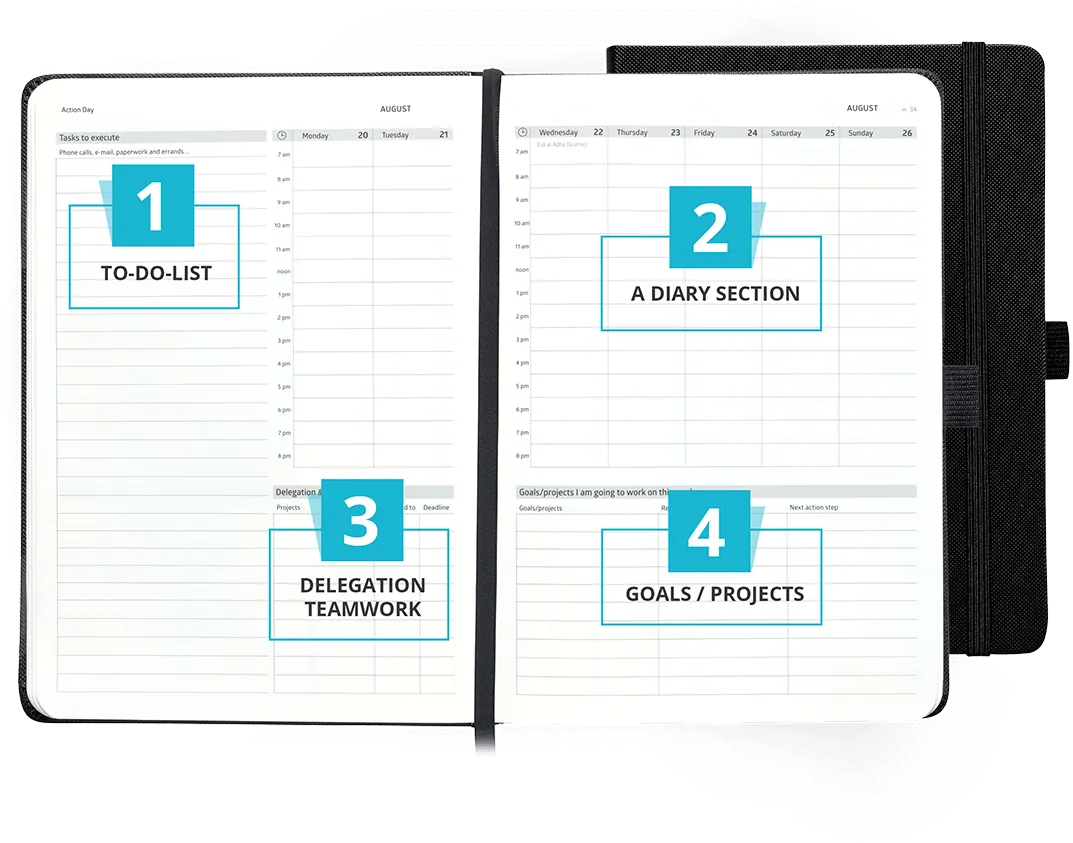
Choose a dated planner if you start in January and want the calendar printed for you; the Yearly Planner is dated from January to December. Choose undated if you start mid-year, skip weeks now and then, or simply want to begin today. The Undated Planners have a four-part weekly layout like the Yearly Planner's, and because you write the dates in yourself, a skipped week costs no pages.
What to write in a planner after setup
Keep the planner for things that have a date or a priority. Appointments and deadlines go on the day they happen. Each week's three priorities go on the weekly spread with their times. Ideas and meeting notes go on the note-taking pages. Long lists of someday tasks belong on a separate page, so they do not crowd out the week.
Keep it alive after January
A planner set up on a quiet evening in December is easy; one still in use in March is the real goal. Open it at the same time each morning for five minutes and check the day's blocks. Once a week, take 20 minutes to plan the next one; our guide on how to plan your week walks through that routine. If you miss a week, nothing is broken: turn to the current week and start again on Monday.
Frequently asked questions
How do I set up a planner for the new year?
Work from the year down to the week. Mark holidays and time off on the yearly calendar, copy fixed dates into the month pages, write three goals on the goals pages, list each goal's first step for January, and plan the first week with three priorities and a start time for each. Twenty minutes is enough.
What should I write in a planner?
Write what has a date and what has a priority. Dates are appointments, deadlines and birthdays. Priorities are the three outcomes for each day or week, each with a start and an end time. Add meeting notes and ideas you want to keep, and leave long lists of someday tasks on a page of their own.
Dated or undated planner?
A dated planner suits you if you start in January, plan every week and like the calendar printed in. An undated planner suits you if you start mid-year, take weeks off from planning, or want to begin today. The weekly layout can be much the same; the difference is who writes the dates.
Can I start an undated planner in the middle of the year?
Yes, that is what an undated planner is for. Write the date of the Monday you start at the top of the first weekly spread and carry on from there. If you skip a week, you simply date the next spread for the week you come back, so no pages go to waste.
What are common planner mistakes?
Three come up most often: setting too many goals, so none gets real attention; writing tasks without times, so they drift from day to day; and skipping the weekly review, so the planner falls out of date and stops being trusted. Fix the last one first, because a short weekly review keeps the other two in check.
When should I buy my 2027 planner?
Early enough to do the 20-minute setup before you want to start planning. For the current edition, its formats and the Amazon listing, see the Yearly Planner product page rather than relying on a date in an article. If you would rather start right away, an undated planner can begin on any Monday of the year.
Keep reading
Related articles
How to Plan Your Week in 20 Minutes (So It Actually Gets Done)
A 20-minute Sunday or Monday routine that turns a crowded head into three outcomes with real times on them.
 If-Then Planning: How to Write a Trigger That Gets You Started
How one sentence decided in advance gets you started, what the research says, and how to write your own.
 Meeting Notes Examples: Four Formats, Filled In
Four meeting formats written out in full, so you can copy the one that fits your next meeting.
