
 How to Plan Your Week in 20 Minutes (So It Actually Gets Done)
A 20-minute Sunday or Monday routine that turns a crowded head into three outcomes with real times on them.
Back to blog
Planner Sizes Explained: A5, 6×8, 7×9, 8×11 and US Letter
Real dimensions, what fits in a bag or on a desk, and which size gives a daily schedule room to breathe.
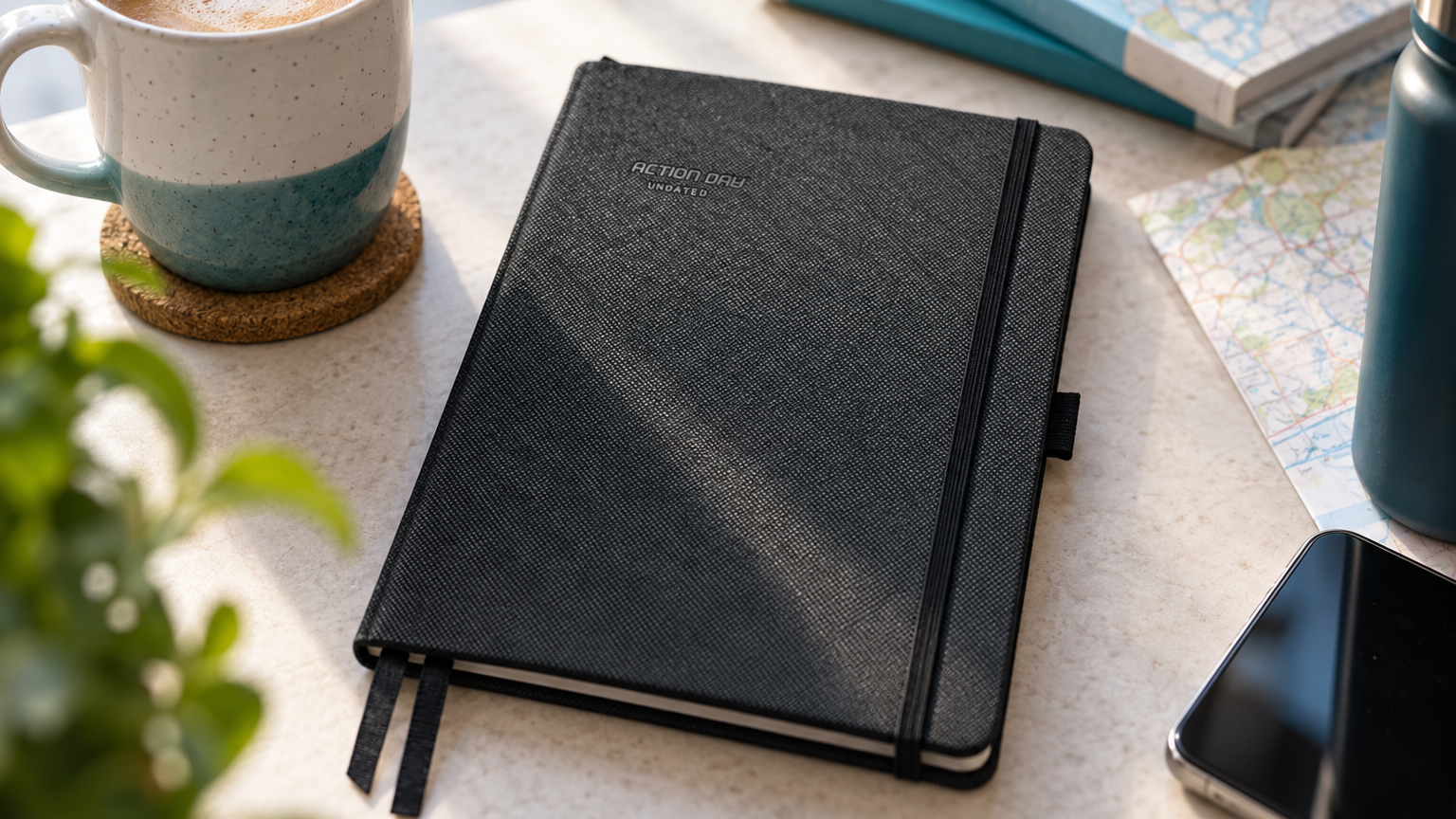
There is no single standard planner size. The common choices are A5 (5.8 × 8.3 in), 6×8, 7×9 and 8×11 inches, plus US letter (8.5 × 11 in). Smaller sizes travel in a bag; larger ones give a daily hourly schedule room to breathe. The table below puts them side by side.
Planner sizes side by side
| Size | Millimeters | Inches | Common use |
|---|---|---|---|
| A6 | 105 × 148 | 4.1 × 5.8 | Pocket lists and quick notes |
| A5 | 148 × 210 | 5.8 × 8.3 | An everyday planner that goes in a bag |
| 6×8 | 152 × 203 | 6 × 8 | Close to A5; a carry-everywhere planner |
| 7×9 | 178 × 229 | 7 × 9 | A desk planner with room for an hourly day |
| B5 | 176 × 250 | 6.9 × 9.8 | Notebooks and larger handwriting |
| 8×11 | 203 × 279 | 8 × 11 | A desk planner close to US letter |
| US letter | 216 × 279 | 8.5 × 11 | Printer paper, binders, full-page planning |
A-series and B-series in two minutes
A and B sizes come from the international ISO 216 paper standard. Each size is half of the one before it: fold an A4 sheet in half and you get A5, fold A5 and you get A6. So the smaller the number, the bigger the page. All A sizes share the same proportions, which is why a layout scaled from A4 to A5 still looks right.
B sizes sit between the A sizes. B5 (176 × 250 mm) is larger than A5, and B6 (125 × 176 mm) is larger than A6 but smaller than A5.
US planner sizes: 5×7, 6×8, 7×9, 8×11 and letter
In the US, planners are usually sold by inches. 5×7 (127 × 178 mm) is close to B6: small, light and easy to carry, with room for lists more than for a full day. 6×8 is close to A5, a little wider and a little shorter. 7×9 is clearly larger than A5, about 3 cm wider and 2 cm taller, and that extra width is what lets an hourly schedule and a task list sit side by side.
8×11 is the same height as US letter and half an inch narrower. Letter itself (8.5 × 11 in) is standard printer paper, so it suits planners that live on a desk or in a binder rather than in a bag.
Action Day® planner sizes
- Undated Planners: 6×8 or 7×9 inches
- Yearly Planner: 7×9 or 8×11 inches
- Timeboxing® Weekly Planner: 7×9 inches
- Timeboxing® Daily Planner: 7×9 inches, spiral bound with a hard cover
- Action Meeting Notebook: 6×8 or 7×9 inches
The Undated Planners are the clearest size choice in the range: 6×8 inches if the planner travels with you, 7×9 inches if it mostly stays on your desk. The range comes in black and turquoise, and because the pages carry no dates, you can start in any week of the year.
How to choose a planner size
Four questions settle most decisions:
- Desk or bag? A planner that lives on the desk can be 7×9 or 8×11. One that goes in a bag every day is easier at 6×8 or A5.
- Do you plan by the hour? A day split into hours, with tasks beside the times, needs width. Below 7×9 the columns get cramped.
- How large is your handwriting? Large handwriting fills a 6×8 line quickly. Small, neat writing fits comfortably.
- One hand or two? If you write standing up or between meetings, a smaller book is easier to hold. At a table, size matters less.
If you plan your week in timeboxes, the larger page pays off; see how to plan your week in 20 minutes for what a full week on paper looks like.
Checklist before you buy
- Measure where the planner will live: the bag pocket or the free space on your desk.
- Look at your busiest day. If it holds several fixed appointments plus focused work, choose 7×9 or larger.
- Write one line of your normal handwriting on a sheet cut to the size you are considering.
- Decide between dated and undated before you choose the size; how to set up a planner covers that choice.
- Check what else you carry. If a meeting notebook travels with the planner, a matching size keeps them together.
Frequently asked questions
What is the standard planner size?
There is no single standard. The most common planner sizes are A5 (5.8 × 8.3 in), 6×8 and 7×9 inches, with 8×11 and US letter for desk planners. A5 and 6×8 suit a bag, while 7×9 and larger suit a desk and an hourly daily schedule. Choose by where the planner lives and how much you write.
Is 7×9 bigger than A5?
Yes. A 7×9 planner measures 178 × 229 mm, while A5 is 148 × 210 mm, so 7×9 is about 3 cm wider and 2 cm taller. That extra width is what gives an hourly schedule and a task list enough room to sit side by side on the same page.
What planner size is closest to US letter?
8×11 inches is the closest common planner size to US letter, which is 8.5 × 11 inches. It is the same height and half an inch narrower. Both suit a planner that stays on the desk, and neither is comfortable to carry in a small bag every day.
Which is better, A5 or B6?
Neither wins outright. B6 (125 × 176 mm) is smaller and lighter, so it is easier to carry and suits short lists. A5 (148 × 210 mm) gives more writing room for notes and a daily schedule. If the planner travels with you all day, B6 is easier; if you plan in detail, A5 fits better.
What size should a work planner be?
Large enough for an hourly column next to your tasks. For a workday planned in timeboxes, 7×9 inches is a practical minimum, which is why both Timeboxing® planners are 7×9. If you mostly record meetings and short lists, 6×8 is enough and easier to carry between rooms.
Which Action Day® planner comes in 6×8?
The Undated Planners and the Action Meeting Notebook both come in 6×8 inches as well as 7×9 inches. The Yearly Planner comes in 7×9 and 8×11, and the Timeboxing® Weekly and Daily planners are 7×9. Choose 6×8 if the book goes with you every day.
Keep reading
Related articles
How to Plan Your Week in 20 Minutes (So It Actually Gets Done)
A 20-minute Sunday or Monday routine that turns a crowded head into three outcomes with real times on them.
 If-Then Planning: How to Write a Trigger That Gets You Started
How one sentence decided in advance gets you started, what the research says, and how to write your own.
 Meeting Notes Examples: Four Formats, Filled In
Four meeting formats written out in full, so you can copy the one that fits your next meeting.
