
 How to Plan Your Week in 20 Minutes (So It Actually Gets Done)
A 20-minute Sunday or Monday routine that turns a crowded head into three outcomes with real times on them.
Back to blog
How to Choose a 2027 Planner: Weekly, Daily, Yearly or Undated
Weekly, daily, yearly or undated? One question decides which 2027 planner you will still be using in March, and this guide matches each answer to an Action Day planner.
Everyone has owned the planner that is full in the first week of January and empty by February. The paper was fine; the planner just did not fit the way its owner works.
To choose a 2027 planner that lasts past January, answer one question first: is your problem knowing what matters, or finding the time to do it? If you lose track of the big picture, choose a yearly planner. If you know your priorities but the day gets away, choose a weekly or daily planner with an hourly schedule. If you are not starting on January 1, choose an undated one. This guide matches each answer to an Action Day® planner.
Þorsteinn Garðarsson started Action Day in 2003 on one belief: planning is only useful when it leads to action. So we judge a planner by what it helps you finish, not by how it looks on a shelf.
The one question that decides it
Most people do not need a prettier planner; they need a different kind of page. Think of the last planner you gave up on and ask which sentence sounds like you:
- "I forgot what was coming." Deadlines, renewals and goals slipped past because nothing showed the whole year. You need the big picture: month pages, goals pages and a weekly view.
- "I knew what mattered, but the day got away." The important task never found a slot between meetings and email. You need an hourly schedule where each priority gets a start and an end time.
- "I stopped for three weeks and could not catch up." Printed dates turned a short gap into a reason to quit. You need pages without dates, so any Monday can be page one.
Pick the sentence that hurts most. That is the planner to buy.
Weekly, daily, yearly and undated at a glance
Four formats, each built for a different answer. Here is the short version.
| Planner | What you get | Size (inches) | Pick it if |
|---|---|---|---|
| Yearly Planner | 2027, January to December: month pages, goals pages, a two-page spread per week | 7 × 9 or 8 × 11 | You lose track of the big picture |
| Timeboxing® Weekly Planner | 53 weekly layout pages with an hourly schedule | 7 × 9 | You know the priorities, but the week gets away |
| Timeboxing® Daily Planner | Daily layout pages with an hourly schedule, spiral bound | 7 × 9 | Your days change and you plan one at a time |
| Undated Planner | Undated month pages and an undated weekly layout | 6 × 8 or 7 × 9 | You start mid-year or skip weeks |
| Action Meeting Notebook | Meeting planning, action items and notes | Check the Amazon listing | Meetings fill your day |
Yearly Planner: the whole year in one place
Some plans only make sense when you can see all twelve months at once. The Yearly Planner is dated 2027, January to December, and covers the year, the month and the week.
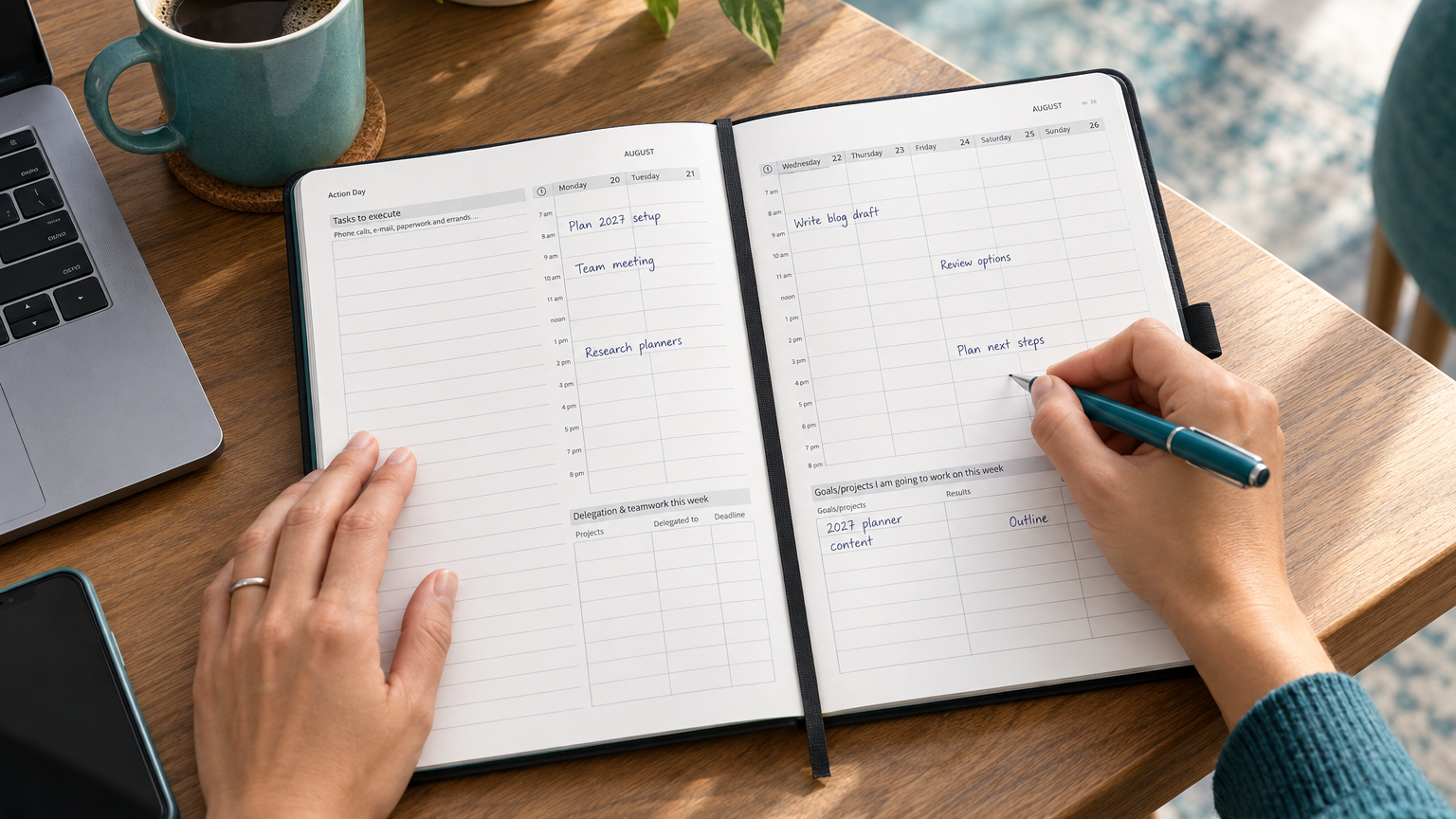
It includes Values & Goals setting pages, month-at-a-glance pages, and a yearly calendar plus the next year's calendar. The weekly time management layout is a two-page spread per week with four sections: a to-do list, a diary section, a delegation and teamwork box for tasks you have passed on to others, and a goals and projects box. There are also 29 pages for note taking.
The hard cover lays flat open 180°, with an elastic closure, an elastic pen loop and an inner pocket, and the pages are 100 gsm acid-free paper. It comes in 7 × 9 or 8 × 11, in black or green.
Choose it if you manage projects, a team or a calendar full of fixed dates. One customer on the product page writes that it was "the fourth year in a row that I've chosen this planner over 'prettier' choices for the sheer utility of it." If you buy it, our guide to setting up your 2027 planner in 20 minutes takes you from the blank cover to a planned first week.
Timeboxing planners: for when you know what matters but not when
A to-do list tells you what to do; a timebox tells you when. The two Timeboxing® planners are built around the Action Day® Method, which has four steps:
- TO-DO: choose your 3 priorities, using the Rule of 3.
- TIMEBOX: give each priority a clear start and end time.
- DO: use an if-then trigger, such as "If it's 9 AM, then I start."
- DONE™: finish what matters by taking the next action step until the work is complete.
On the page, that becomes an hourly schedule column, starting at 6 am, next to a to-do list for the three most important tasks. You write the three, then block out a slot for each. Both planners are 7 × 9 inches, with personal and career goals pages and 24 dot-grid note-taking pages.
In a 2018 analysis by Filtered of 100 productivity techniques, written up in the Harvard Business Review, timeboxing ranked first. Our guide to what timeboxing is and why it beats a to-do list explains why.
Weekly or daily?
Same method, different zoom. The Timeboxing Weekly Planner has 53 weekly layout pages, each spread across two pages, plus a daily, weekly and monthly calendar. It has a flexible soft cover with a bookmark and elastic closure, and it comes in black, pink or green. Choose it if you plan once a week and want to see all seven days together. Our guide to planning your week in 20 minutes shows what that looks like on paper.
The Timeboxing Daily Planner gives each day its own layout page with to-do lists, a timeboxing schedule and notes. It is spiral bound with a hard cover, in black. Choose it if your days change and you would rather plan one at a time.
For the current edition of either planner, check its product page and Amazon listing.
Undated Planner: start any week of the year
An undated planner does not know what month it is, which is exactly its strength. The pages carry no dates, so you write the date on the first spread and begin in any week. If you skip a week, you date the next spread when you come back and no pages are wasted.
The Undated Planner keeps the four-section weekly spread of the Yearly Planner, with undated month-at-a-glance pages, Values & Goals setting pages and 29 dot-grid note-taking pages. It has a hard cover that lays flat open 180°, an elastic closure, an elastic pen loop, an inner pocket and 100 gsm acid-free paper. It comes in 6 × 8 or 7 × 9 inches, in black or turquoise.
Choose it if you start a new job in June or simply want to begin today. Our guide to making a fresh start with the Action Day Method shows how to begin on any Monday.
Action Meeting Notebook: when meetings fill the day
If most of your calendar belongs to other people, your notes matter as much as your plan. The Action Meeting Notebook is a non-dated notebook with spreads for meeting planning, action item review, an action plan and meeting notes, plus date, start and end fields on the page.
It has a table of contents, numbered pages, a ribbon bookmark and a hard cover that lays flat open 180°. Treat it as a partner to a planner rather than a replacement: the planner holds your three priorities, and the notebook turns each meeting into next steps.
Which 2027 planner is right for you?
Still undecided? Find the sentence that sounds most like you.
- "I lose track of the big picture." Choose the Yearly Planner: 2027, January to December, with goals pages and a weekly spread.
- "I plan once a week and want the whole week in view." Choose the Timeboxing Weekly Planner, with an hourly schedule and a to-do list for your three most important tasks.
- "My days change and I plan them one at a time." Choose the Timeboxing Daily Planner, with a page for each day.
- "I am starting mid-year, or I skip weeks." Choose the Undated Planner and begin on any Monday.
- "My calendar is mostly meetings." Add the Action Meeting Notebook to whichever planner you pick.
Whichever you choose, give it one evening before the first Monday. A planner that starts with three priorities and a start time is the one you will still be opening in March.
Frequently asked questions
When should I buy a 2027 planner?
Buy it early enough to set it up before you want to start planning, ideally a few weeks before January. The 20-minute setup routine then gives you fixed dates, goals and a planned first week. For the current edition, check the product page.
Should I choose a dated or undated 2027 planner?
Choose dated if you start in January and plan every week; the Yearly Planner's 2027 edition runs January to December. Choose undated if you start mid-year, skip weeks now and then, or want to begin today. The weekly layout can be much the same; the difference is who writes the dates.
Which planner size should I choose?
Choose by where the planner lives. A 7 × 9 page, the size of both Timeboxing planners, gives an hourly schedule room to sit beside your tasks. The 6 × 8 Undated Planner is easier to carry, and the 8 × 11 Yearly Planner suits a desk. Our planner size guide has the dimensions in millimeters and inches.
Is a weekly or daily 2027 planner better?
Choose weekly if you plan once a week and want to see all seven days at once. Choose daily if your days change and you plan one at a time. Both Timeboxing planners use the same method. If you want a dated 2027 weekly planner, the Yearly Planner also has a weekly spread.
What is the best planner for productivity?
The best planner for productivity is the one that makes you decide three things before the day starts: your priorities, when you will do each one, and what triggers the start. That is the Action Day Method. A planner with a short priority list, an hourly schedule and room for notes makes those decisions visible.
What is the difference between timeboxing and time blocking?
Time blocking reserves a stretch of time for a type of work, such as email or deep work. Timeboxing gives one specific task a fixed start and end time, and the work stops when the box ends. A good paper plan uses both, and the hourly column in the Timeboxing planners handles either. Our guide to timeboxing vs. time blocking compares them side by side.
Keep reading
Related articles
How to Plan Your Week in 20 Minutes (So It Actually Gets Done)
A 20-minute Sunday or Monday routine that turns a crowded head into three outcomes with real times on them.
 If-Then Planning: How to Write a Trigger That Gets You Started
How one sentence decided in advance gets you started, what the research says, and how to write your own.
 Meeting Notes Examples: Four Formats, Filled In
Four meeting formats written out in full, so you can copy the one that fits your next meeting.
